

How a fragmented international trading brand was transformed into a coherent global platform, then evolved again to support new products, audiences and markets – contributing to revenue doubling to more than £1 billion.
The business challenge
When I joined IG in late 2019, brand had been identified as an important part of delivering the company’s growth strategy. The business was strong, with a well-established reputation for product quality, market access and execution, particularly among experienced traders. But the brand itself had been neglected.
IG operated across 17 markets, yet there was very little consistency between them. Each country had evolved independently, with different uses of the logo, imagery, tone of voice, messaging, propositions and reasons to choose the brand. In practice, it often felt like 17 different brands that happened to share the same name.
There was also no clear global positioning tying those markets together. IG was respected for what it did, but it lacked a distinctive expression of what it stood for and why that should matter to customers.
The immediate priority was therefore to strengthen brand equity through greater coherence, awareness and consideration, while creating a global platform strong enough to support the company’s future growth ambitions.
The challenge was to make IG feel like one brand everywhere in the world without removing the local relevance that had helped individual markets succeed.
What the analysis revealed
We started with a comprehensive diagnosis of the brand, customers and competitive environment. That included customer and prospect research, segmentation, competitor analysis, brand tracking, stakeholder interviews, existing communications and detailed audits across the individual markets.
The first issue was structural. Competitors were generally more consistent in how they presented themselves, even where they did not have IG’s scale or product strength. IG had the stronger underlying business in many areas, but that advantage was not being translated into a coherent global brand.
The more interesting finding came from understanding the psychology of traders.
Trading is not for everyone. It requires confidence, knowledge and a willingness to act in situations where most people simply observe what is happening. Research with customers highlighted a distinctive characteristic of experienced traders: they interpret the world differently.
Where other people might see an election, an interest-rate decision, a company announcement or a sudden market movement, a trader sees the possibility of an opportunity.
That led to the central strategic insight:
Where others see events, traders see opportunities
This shifted the brand away from another list of functional trading benefits and towards something rooted in the mindset of the customer.
The first strategic shift: build one global IG
The first phase of the transformation focused on IG’s existing strength: experienced traders. These customers already understood markets and had their own trading strategies. They did not need IG to explain why they should trade. They needed a platform capable of helping them act when they identified an opportunity.
IG had strong credentials in this area. It offered access to more markets than its competitors, had a reputation for execution quality and provided the technology, expertise, tools and support that active traders expected.
The brand promise therefore centred on helping experienced traders recognise and act on the opportunities they saw.
That thinking ultimately became:
See it. IG it.
It was a simple expression of a much broader strategy. If you could see an opportunity, IG gave you the capability to act on it.
For the first time, IG had a global idea capable of connecting what the business was good at with what mattered to its customers.
How the first strategy worked
Create global consistency without losing local relevance
The goal was never to create a rigid central brand and simply impose it on 17 markets.
Local teams were involved throughout the development process. Their input helped ensure that the positioning could work across different cultures and levels of market maturity, while also creating ownership among the people who would ultimately have to use it.
The resulting model defined the elements that needed to remain consistent globally – including the positioning, promise, visual identity, logo, colour system and tone of voice – while giving markets freedom in how those principles were expressed locally.
Markets could adapt language, choose the most relevant reasons to believe, use locally appropriate imagery and social content, and select channels based on local customer behaviour.
The principle was straightforward: global consistency where it built equity, local flexibility where it improved relevance.
Build a complete global brand system
The transformation extended well beyond visual identity.
Working with Wolff Olins, we developed a new global system encompassing positioning, messaging, visual identity, typography, colour, imagery, tone of voice, motion and digital expression.
That provided the organisation with a common strategic and creative framework for the first time. Instead of individual markets repeatedly reinventing IG, they could build from the same global foundations.
The benefit was not simply consistency. It also made future marketing more efficient because markets no longer needed to solve the same strategic and brand questions independently.
Launch the brand as one global organisation
The new brand launched on 3 June 2020 across all 17 markets.
Rather than rolling it out gradually, we treated the transformation as a global reset. Markets went live one hour apart on the same day, with the system localised across 22 languages to account for differences within markets as well as between them.
The launch demonstrated the operating model we were trying to create: one global brand, expressed appropriately in each market.
Bringing the first strategy to life
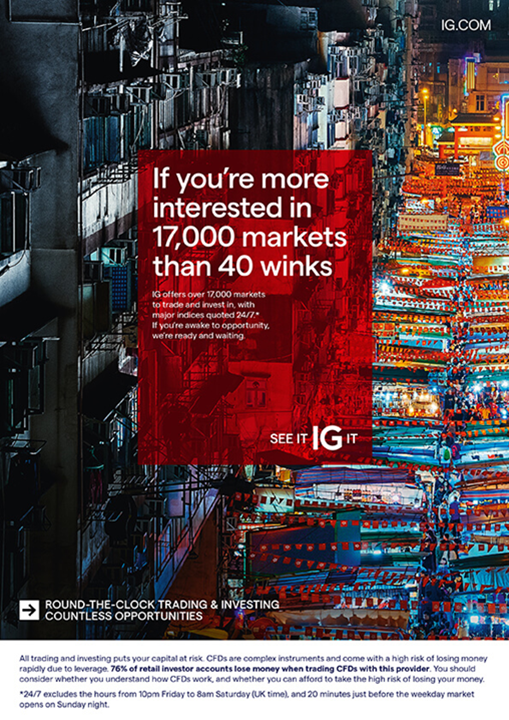
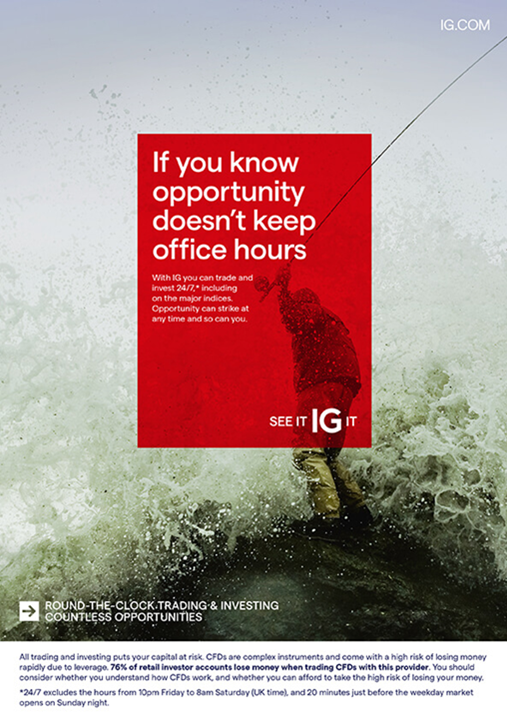
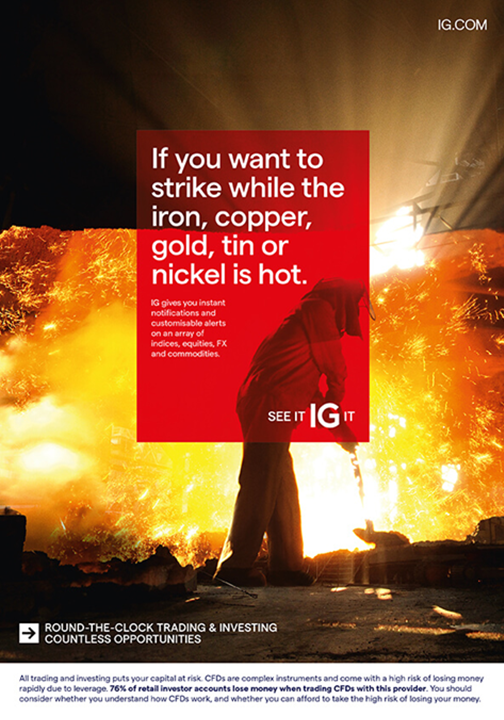
“See it. IG it.” became the global campaign expression of the new positioning.
The idea focused on the moments traders recognise as opportunities – moments that most people might simply see as news or events. This allowed the brand to connect emotionally with the mindset of experienced traders while still giving IG room to demonstrate the functional capabilities that enabled them to act.
The campaign was tested before launch across key markets including the UK, Germany, France, Italy, Australia and Japan. Research showed 74% saliency, 78% understanding and 65% consideration, giving us confidence that the platform could attract attention, communicate its meaning clearly and positively influence consideration.
Most importantly, the campaign gave the business a consistent global expression of the strategy. Media and execution could change from market to market, but the idea being built in customers’ minds remained the same.
The business strategy changed – so the brand had to change with it
By 2023, IG’s growth strategy had evolved.
The business was increasingly looking for growth through diversification: entering new markets, launching new products and attracting audiences beyond its traditional core of experienced leveraged traders.
That created a different challenge for the brand.
The first transformation had successfully created global coherence and strengthened IG’s position with experienced traders. But a brand built primarily around that audience could not simply be stretched indefinitely as the business moved into investing products and sought to attract people who were newer to trading.
At the same time, the competitive environment had moved on. Competitors were improving their brands, while traditional functional advantages such as pricing, spreads, market access and platform capability were becoming easier to match.
We therefore needed to shift the basis of competition again.
The second strategic shift: compete on experience
The next phase of the brand strategy moved the focus from individual functional benefits towards the quality of the overall experience IG could provide.
The opportunity was to create an experience that was open, immersive and personal, drawing together the breadth of the group’s capabilities around the customer.
At the centre of the strategy was a new brand promise:
Inspiring confidence
This deliberately worked differently depending on the customer.
For someone new to trading or investing, confidence meant helping them overcome uncertainty. IG could provide the education, support, tools and simpler product experiences needed to build their knowledge and participate with greater confidence.
For experienced traders, the meaning was different. Confidence came from knowing that they were using a platform with the market access, execution, expertise and technology required to support their strategy and help them act when opportunity appeared.
The promise therefore allowed the brand to broaden its appeal without abandoning the experienced traders who had always been central to IG.
How the second strategy worked
Move brand into the customer experience
The second phase deliberately extended the role of brand beyond communications.
If IG wanted to attract newer audiences, the experience itself had to change. Onboarding was simplified, training and educational content were integrated more deliberately into the journey, and screens were made easier to navigate for customers who did not arrive with the same level of trading knowledge as IG’s traditional audience.
Brand strategy was therefore beginning to shape product and service experience directly.
This was an important evolution. “Inspiring confidence” could not simply be something IG said in advertising. Customers needed to experience it through the way the business helped them learn, navigate products and make decisions.
Build an ecosystem around the customer
The diversification strategy also changed how we thought about brand architecture across the group.
IG owned and operated a number of brands and businesses, but historically these had not always worked together as a coherent ecosystem. The new strategy looked at the role each could play in serving different customer needs and supporting the group’s future growth.
Some businesses that no longer fitted the strategic direction were sold. Others were acquired because they brought capabilities the group needed. The acquisition of tastytrade, for example, strengthened IG’s position in the US and provided greater access and credibility in options trading.
Existing brands were also reconsidered. DailyFX had historically operated more independently, but its news, research and analysis could play a much more valuable role when integrated into the broader IG customer experience.
Brand architecture therefore became part of the growth strategy rather than simply an exercise in naming or identity.
Making a global brand work in practice
A global strategy only creates value if people throughout the organisation use it consistently.
Stakeholder involvement had been important from the beginning, but the second transformation required an even broader programme of internal adoption. More than 2,000 colleagues were trained on the new strategy and brand, supported by a network of Brand Champions across the organisation.
Quarterly brand reviews helped maintain standards across markets, while the central brand team remained involved at key stages of major campaigns and initiatives.
The operating model was designed to avoid two extremes: markets operating completely independently, as they had in the past, or a central team trying to control every piece of execution.
Instead, central brand leadership set the strategic direction and protected the elements that built global equity, while local teams retained the ability to make the brand relevant to their customers.
The brand impact
The transformation delivered measurable improvements against the brand objectives established at the outset.
Awareness increased 5% year on year
Brand tracking across key markets recorded a 5% YoY improvement in awareness, demonstrating that a more coherent and consistently supported global brand was becoming more visible to customers.
Consideration increased 10% year on year
Consideration grew even faster, increasing 10% YoY in key markets.
This was particularly important because the objective was never simply to make IG more recognisable. The brand needed to give customers stronger reasons to put IG into their consideration set.
Marketing investment became more efficient
The transformation was also supported by greater investment in measurement and marketing effectiveness.
Marketing-mix modelling was used to understand performance and optimise media allocation. Successive optimisation cycles improved media efficiency by around 15–20%, while ROI improved by approximately 5–10% per iteration.
That brought greater commercial discipline to brand investment and provided a clearer link between marketing decisions and business outcomes.
The commercial impact
Brand was one part of a much broader business transformation, so it would be wrong to attribute IG’s commercial growth to brand alone.
But brand had been identified by the business as a critical component of delivering the growth strategy, and over the five-year transformation the company changed substantially.
Revenue grew from under £500m to more than £1bn
Over the period, IG’s annual revenue more than doubled, passing £1 billion.
The business was also becoming more diversified across products, markets and customer groups — exactly the shift the second wave of the brand strategy had been designed to support.
The share price increased by as much as 44%
Across the same five-year period, IG’s share price rose by as much as 44% from the starting point.
Many factors contributed to that performance, from market conditions and product development to acquisitions and commercial execution. The contribution of the brand transformation was to create a stronger global platform behind that growth: building greater equity, improving consistency and giving the organisation a brand capable of stretching as its strategy changed.
Why the strategy worked
The first strength was that the brand strategy remained connected to the business strategy throughout the five-year transformation.
In 2019, the immediate problem was fragmentation. IG needed to become one coherent global brand capable of building awareness and consideration across markets. Once that foundation had been established and the business moved towards diversification, the brand strategy evolved with it.
The second strength was the depth of the customer insight. The first positioning was built around something psychologically distinctive about experienced traders rather than another functional trading claim. The second then recognised that different levels of experience required different forms of confidence, allowing IG to broaden its audience without losing relevance to its traditional customer base.
The global operating model was equally important. Involving local teams in creating the strategy helped build ownership, while clear non-negotiables protected the equity being created centrally.
And over time, brand expanded beyond marketing communications into areas such as customer experience, education, onboarding and brand architecture. That gave it a much more meaningful role in helping the organisation execute its growth strategy.
Capabilities demonstrated
Global Brand Strategy | Brand Transformation | Growth Strategy | Brand Positioning | Brand Architecture | Customer Insight | Customer Experience | Global Operating Model | Integrated Marketing | Marketing Effectiveness
My role
As Global Head of Brand Marketing, I led the five-year transformation of the IG brand. This included the initial brand diagnosis and global positioning, development and rollout of the new identity, global governance and adoption, brand tracking and marketing effectiveness, and the subsequent evolution of the brand as the business moved towards a more diversified growth strategy.
I led the work with my team and worked closely with senior leadership, local marketing teams and other functions across the business, as well as agency partners including Wolff Olins and Saffron.
This work was completed while I was Global Head of Brand Marketing at IG Group.